
The Fastest Way to Get CMMC Level 2 Compliant: How Suppliers Can Cut Their Preparation Time in Half
CMMC is Changing. Protecting CUI Is Still the Mission
As of July 13, the Department of War (DoW) has suspended the requirements for CMMC Phase 2 implementation, and the program is under a 60-day review. We are actively updating our content to reflect the latest information. Guidance for protecting Controlled Unclassified Information (CUI) and supporting NIST SP 800-171 remains unchanged.
CMMC 2.0: Waiting Is No Longer an Option
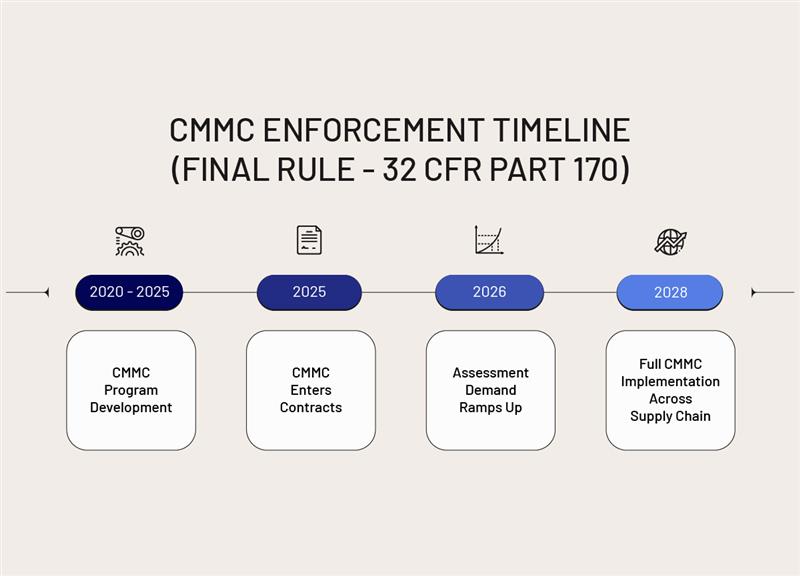
In November 2025, the DFARS 252.204-7021 clause that embeds CMMC into defense contracts entered into effect, with a phased rollout running through 2028. CMMC Level 2 compliance enforcement activity has already started and will continue expanding as contracts require either self-assessments or third-party assessments.
Primes like Lockheed Martin are already requiring suppliers to demonstrate NIST SP 800-171 implementation, submit SPRS scores, and show clear progress toward CMMC readiness.
This is not a time to panic, but a time to take action. The fastest path is not about rushing controls individually but about taking a structured approach that prepares organizations for their assessment.
Why Speed Matters Now: The New CMMC Reality
Now that it is clear CMMC 2.0 is here to stay, organizations across the Defense Industrial Base must take CMMC Level 2 readiness seriously. The compliance clock is already running, and delaying action only increases risk.
If you have not yet seen the CMMC requirement (DFARS 7021) in your contracts, you soon will. Not every contract includes DFARS 7021 yet, but that will become progressively more common during the rollout. DIB suppliers will face a mix of self-assessments, C3PAO reviews, and prime contractor oversight. There is a limited number of C3PAO assessors available, which creates a backlog. In short, prime contractors are accelerating expectations, and CMMC Level 2 prep now affects competitive standing and contract eligibility.
CMMC will impact your business continuity and revenue which requires strategic planning rather than reactive IT projects. Organizations seeking a faster path must shift from tactical control by control work to a structured and hollistic planning approach.
The Slow Path vs. the Fast Path
The standard path often emerges when organizations treat CMMC Level 2 compliance requirements as a one-time IT project rather than a repeatable security and compliance program.
Controlled Unclassified Information (CUI) often ends up scattered across file shares, email, and user endpoints because teams continue working as they always have. Simultaneously, teams create documentation ad hoc without a consistent framework to guide how they describe or track controls. Organizations also rely on familiar but disconnected tools like spreadsheets, which makes it difficult to maintain a reliable view of control status or evidence.
The result is a CMMC Level 2 compliance effort that becomes harder and more expensive over time. The fast path focuses on essential activities that support faster organizational readiness, clearly contain CUI, organize all 110 NIST SP 800-171 security requirements that underpin CMMC Level 2, and maintain evidence that accurately reflects daily operations.
CUI Enclaves
Let’s talk about containing CUI. This is where the concept of an enclave comes in. A CMMC enclave isolates all systems that store, process, or transmit CUI, reducing scope and enabling consistent, enforceable security controls. Solutions such as virtual desktops or hosted CUI environments support rapid onboarding, centralized administration, and standardized handling practices for distributed teams. Rather than hardening the entire enterprise, organizations can use a CMMC enclave to protect the smallest viable boundary, which often leads to a more efficient implementation, assessment, and CMMC certification process.
Documentation & Assessment
Documentation is one of the biggest causes of delays in CMMC Level 2 prep because creating SSPs, policies, POA&Ms, and evidence requires coordination across your business. Assessors expect these artifacts to be complete, consistent, and aligned with actual practice. Common blockers include unclear ownership, version-control issues, conflicting interpretations of requirements, and fragmented evidence, each of which creates rework long before an assessor is involved.
With standardized documentation and organized evidence, suppliers gain a clear, measurable picture of readiness across 110 NIST SP 800-171 security requirements for CMMC Level 2.
Assessment Readiness
Assessment readiness depends not only on documentation but also on the consistent execution of controls and proof that daily practice matches what is written. Prime contractor evidence reviews are becoming more common as major primes work to strengthen their supply chains and reduce risk. Continuous compliance requires structured review cycles, updated POA&Ms, recurring training, access validations, and change monitoring, ensuring your posture does not drift over time.
Trusted partners help interpret requirements, validate scope, and prepare you for your assessment.
A Phase-Based Framework for CMMC Level 2 Readiness
Every organization’s journey to CMMC Level 2 is unique, but most successful programs follow a well-defined sequence. Instead of attempting to tackle all 110 controls at once, a phased approach keeps teams focused and creates a strong, repeatable compliance foundation.
The phases below outline a practical way to begin without implying any timeline or pace.
Phase 1: Establish Clarity and Define Scope
The first step is understanding exactly what is in scope for CMMC. This phase lays the groundwork for every decision that follows.
- Confirm whether your organization handles CUI and which DFARS clauses apply to your contracts.
- Map where CUI is stored, processed, and transmitted so you can determine the assessment boundary.
- Evaluate containment strategies, such as segmenting systems or using a dedicated CUI environment, to reduce complexity.
- Assign internal responsibilities so everyone understands ownership for documentation, evidence, controls, and review cycles.
By the end of this phase, organizations know exactly what they must protect and what falls within their CMMC assessment boundary.
Phase 2: Build the Environment and Begin Documentation
Once you understand the scope, align your environment and documentation with NIST SP 800-171 requirements. This phase lays the foundation for a defensible compliance program.
- Implement or refine security controls necessary to protect CUI, focusing on access, assessment, configuration management, and other key areas.
- Establish or strengthen the secure environment where CUI will live, whether that’s an enclave, segmented systems, or another compliant structure.
- Conduct structured assessments across all 110 controls to understand your current posture.
- Develop the required documentation, including the System Security Plan (SSP), policies, procedures, and the Plan of Action and Milestones (POA&M).
- Prioritize remediation steps that are both achievable and reduce the highest levels of risk.
This phase ensures organizations have the technical safeguards, and the organized documentation that assessors expect, with each requirement clearly mapped to all 110 controls.
Phase 3: Prepare for Assessment and Strengthen Governance
With controls and documentation in place, attention shifts to demonstrating consistent execution and maintaining long-term readiness.
- Validate that evidence exists for each control and that it aligns with the practices described in your SSP.
- Perform internal readiness reviews or mock assessments to identify remaining gaps or inconsistencies.
- Ensure policies and procedures align with daily practices, as misalignment is a common source of findings during assessments.
- Establish ongoing activities such as monitoring, recurring training, access reviews, and periodic reassessments to maintain compliance over time.
This final phase is about creating confidence. When governance is strong and practices are repeatable, organizations are better prepared for C3PAO assessments, self-assessments, and prime contractor reviews.
Positioning Your Organization for Readiness and Resilience
The fastest path to CMMC Level 2 requires three outcomes: containing CUI, documenting all 110 NIST SP 800-171 requirements, and maintaining continuous assessment readiness. Achieving these outcomes protects revenue and strengthens competitive positioning.
Exostar’s CMMC Ready Suite brings together secure CUI infrastructure, guided self-assessments with policy and document management, and expert partner support to help you address all 110 NIST SP 800-171 requirements and maintain CMMC Level 2 readiness.
With one unified solution that supports NIST SP 800-171 controls, organizations can simplify their compliance journey and approach CMMC Level 2 with confidence.
FAQ: The Fast Way to Get CMMC-Compliant
CMMC Level 2 compliance requires the implementation of all 110 security controls defined in NIST SP 800-171, spanning 14 families, including Access Control, Audit and Accountability, Configuration Management, and Incident Response. Organizations must also maintain a System Security Plan (SSP), supporting policies, and evidence that each control is operating as documented.
A CMMC enclave is a dedicated environment that isolates every system storing, processing, or transmitting CUI. By containing CUI within a defined boundary, organizations reduce the number of systems subject to assessment. They can apply consistent controls across a smaller footprint, which simplifies CMMC Level 2 preparation and ongoing maintenance.
Most organizations need 6 to 18 months for CMMC Level 2 readiness, depending on their starting maturity. C3PAO scheduling backlogs can add months. Working with CMMC readiness timeline acceleration vendors who handle infrastructure, documentation, and assessment preparation in parallel can compress the timeline significantly.
The fastest way to get CMMC Level 2 readiness is a phased approach: define your CUI boundary, contain CUI in a secure enclave, document all 110 controls using a structured platform rather than spreadsheets, and validate with mock assessments before engaging a C3PAO. A unified solution eliminates the coordination overhead that slows most organizations down.
Yes. Organizations can receive conditional CMMC Level 2 certification with a Plan of Action and Milestones (POA&M) in place, provided all remaining items are closed out within 180 days. Not every control is eligible for a POA&M, so identifying gaps early is critical to keeping certification on track.