
CMMC POAMs: A Guide to the CMMC Plan of Action and Milestones
What’s New (Updated POA&M Eligibility and Limits)
This blog reflects the CMMC Final Rule (32 CFR Part 170), enforceable as of November 10, 2025. POA&Ms are now permitted only under specific, limited conditions for Level 2 and Level 3 requirements, with strict eligibility rules and a 180-day closeout window. This post updates references to POA&Ms that previously described them as broadly available or part of a future compliance process.
Understanding CMMC POAM Requirements in Today’s Compliance Environment
Whether you are new to Cybersecurity Maturity Model Certification (CMMC) or have already started a System Security Plan (SSP) and self-assessment, concerns are common. Many organizations do not yet meet all 110 NIST SP 800-171 controls.
While a Plan of Action and Milestones (POA&M or POAM) can help bridge the gap in the interim, there are some caveats worth keeping in mind. In this post, we’ll outline how a CMMC POAM fits into the other CMMC documentation steps you must take on the journey to CMMC readiness and share POA&M limitations and guidelines.
If you are unfamiliar with many of the preceding acronyms, then please read these two posts that share an overview of CMMC and NIST SP 800-171. Although POA&Ms offer limited, time-bound remediation under the Final Rule, organizations must still create an SSP. They must also satisfy most NIST SP 800-171 controls before beginning formal certification.
What Is a POA&M in CMMC Compliance?
A CMMC POA&M is a document that identifies tasks an organization must accomplish to resolve security weaknesses. This document details the resources required to accomplish elements of the plan, any milestones for meeting the tasks, and scheduled completion dates, among other information.
Previously, the Department of Defense (DoD) did not allow organizations to use a Plan of Action and Milestones during the CMMC compliance process. However, under CMMC 2.0, contractors meeting most of the controls laid out by NIST SP 800-171 can use time-limited POA&Ms to maintain contracts. Under the Final Rule, contractors that meet strict eligibility criteria may use time-limited POA&Ms for certain non-critical controls. This applies to both CMMC compliance at level 2 or level 3. This contingency plan ensures organizations have time to implement CMMC 2.0 requirements and correct cybersecurity vulnerabilities without losing valuable contracts.
How POA&Ms Impact the CMMC 2.0 Assessment Process
First, determine which CMMC 2.0 maturity level applies to your organization. The DoD only allows POA&Ms for CMMC levels 2 and 3.
Your organization will begin preparing for a CMMC 2.0 assessment by:
- Performing a gap analysis against the 110 NIST SP 800-171 controls.
- Developing an SSP that documents your current cybersecurity posture.
- Completing a self-assessment and reporting the score to the Supplier Performance Risk System (SPRS).
Self-assessment scores range from -203 to 110. Under the Final Rule, organizations need a minimum SPRS score of 88 for Conditional Level 2 eligibility.
CMMC POAM Requirements and Limitations
Beginning the formal CMMC assessment process with a CMMC Third-Party Assessor Organization (C3PAO) requires a SPRS score of at least 88. Each NIST SP 800-171 control is worth 1, 3, or 5 points, and POA&Ms are only allowed for 1-point controls, excluding the following 1-point CMMC CUI controls for CMMC level 2:
- AC.L2-3.1.20 – External Connections (CUI Data)
- Verify and control/limit connection to and use of external systems.
- AC.L2-3.1.22 – Control Public Information (CUI Data)
- Control CUI posted or processed on publicly accessible systems.
- PE.L2-3.10.3 – Escort Visitors (CUI Data)
- Escort visitors and monitor visitor activity.
- PE.L2-3.10.4 – Physical Access Logs (CUI Data)
- Maintain audit logs of physical access.
- PE.L2-3.10.5 – Manage Physical Access (CUI Data)
- Control and manage physical access devices.
One 5-point control may also permit a POA&M, SC.L2-3.13.11, if it is partially met—encryption is employed but is not Federal Information Processing Standard (FIPS) validated—reducing a SPRS score by 3 points instead of 5.
For reference, these POA&M guidelines are defined in the CMMC Final Rule: Section 170.21 on POA&Ms. View additional POA&M control exemptions for CMMC maturity level 3 in the linked section. POA&Ms are not permitted for CMMC maturity level 1 controls.
What a CMMC POA&M Must Include
Each POA&M you open must contain the following information necessary for review and approval by a third-party assessor or for a self-assessment submission:
- The relevant control
- The responsible party
- Planned actions to meet the control
- Start and completion dates
- Milestones to meet and interim completion dates
- The actual actions taken
- Status (ongoing or complete)
A minimal POA&M example would resemble the following:
Control: AC.L2-3.1.3: CUI Flow Control
Deficiency: Organization has not fully implemented mechanisms to control the flow of CUI between network segments. Internal traffic between the engineering subnet and general office network is not restricted.
SPRS Point Value: 1
Status: Open
Responsible Party: IT Security Manager
Planned Remediation: Deploy network segmentation rules and access control lists (ACLs) on internal firewalls to restrict CUI flow to authorized segments only.
Milestones:
-
- Document current network topology and CUI data flows (Week 2)
- Configure ACLs and firewall rules on internal segments (Week 6)
- Test and validate segmentation controls (Week 8)
- Update SSP to reflect implemented controls (Week 9)
Completion Deadline: 180 days from conditional certification
Closing Out a POA&M
Under the Final Rule, organizations must resolve vulnerabilities and close out POA&Ms within 180 days of receiving a Conditional Level 2 certification.
If the POA&M was created during an annual self-assessment, your organization will perform the closeout assessment. If it was identified by a C3PAO or certified CMMC assessor during a triennial assessment, the third party will perform the closeout assessment, which may require an additional on-site visit.
POA&M Example Scenario: How a Mid-Sized Supplier Uses POA&Ms
Imagine a mid-sized defense subcontractor that scores an 89 on its SPRS self-assessment. While most controls are met, the company has three open items that qualify for POA&Ms.
Using a structured tracking tool, the supplier:
- Assigns remediation tasks to IT staff
- Sets automated due dates for closure
- Uploads evidence of completed fixes
- Tracks overall progress toward compliance
By systematically addressing CMMC POA&Ms within the 180-day window, the organization not only protects its DoD contracts but also improves its long-term cybersecurity posture.
How to make a POAM with Exostar Certification Assistant
Complying with DoD POAM standards can be a complex and time-consuming process. Exostar’s Certification Assistant™ is a cloud-based tool designed to streamline the CMMC self-assessment process in alignment with NIST SP 800-171 and CMMC.
Simplify your CMMC compliance journey with a secure tool where you can:
- Complete your self-assessment
- Calculate your SPRS score
- Generate your SSP with one click
- Securely store and handle documentation
If your organization is relying on POA&Ms to close remaining gaps, now is the time to ensure they are eligible, well-documented, and achievable within the Final Rule’s strict timelines. Explore tools that help defense contractors manage SSPs, SPRS scoring, and POA&M tracking in a centralized, assessment-ready environment.
Certification Assistant™ enables your organization to gather all necessary CMMC documentation for outside assessors in one secure space to readily satisfy third-party assessments.
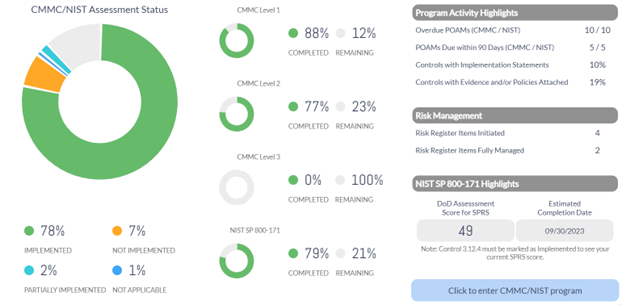
Purchase Certification Assistant™ today. Exostar® endeavors to make CMMC compliance simple and affordable for prime and subcontractors—please connect with an expert to learn more.
Here’s What You Need to Do Now
To comply with the Final Rule, organizations should verify whether POA&Ms are permitted for their required CMMC level, confirm SPRS score eligibility, and identify which NIST SP 800-171 controls are excluded from POA&M use. Ensure SSPs accurately reflect current control implementation, assign ownership for POA&M remediation, and plan to close all eligible POA&Ms within the 180-day window. Preparing documentation and evidence upfront reduces the risk of failing a conditional assessment.